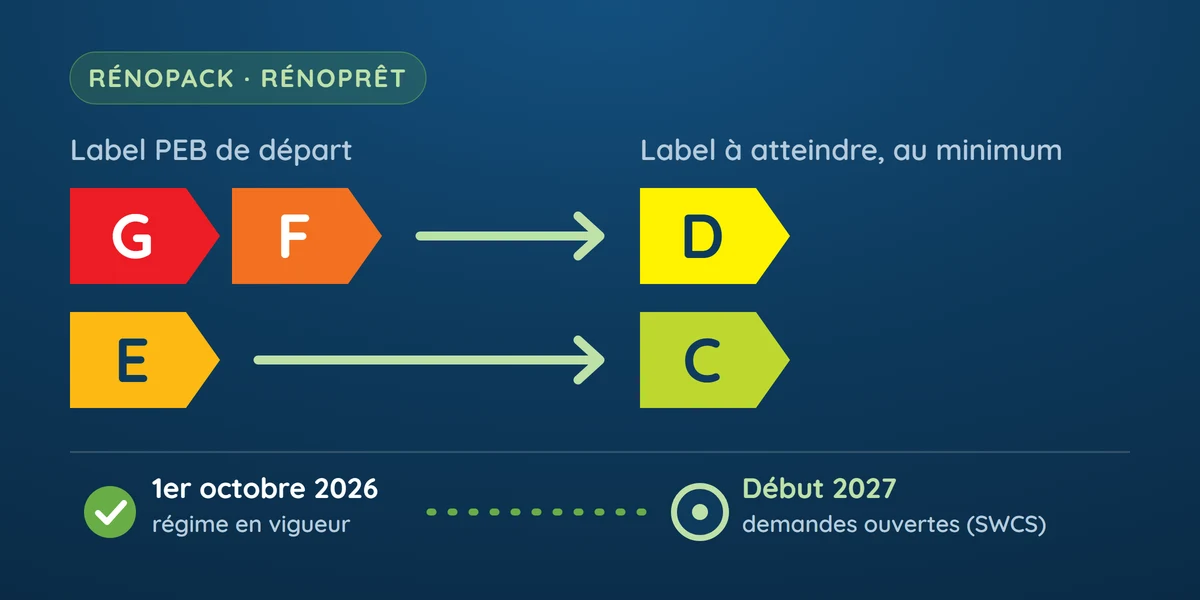
Depuis le 1er octobre 2026, la Wallonie ne verse plus de primes à la rénovation : elle prête. Le soutien régional passe par deux formules, le Rénopack et le Rénoprêt, avec un audit préalable et un label PEB à atteindre après travaux. Beaucoup de choses ont été écrites sur le sujet, souvent avant l'adoption des textes. Voici les principes tels que la Région et la Société wallonne du Crédit social (SWCS) les publient aujourd'hui, et ce que j'en retiens pour un propriétaire.
Since 1 October 2026, Wallonia no longer pays renovation grants: it lends. Regional support now comes through two products, the Rénopack and the Rénoprêt, with a prior audit and an EPC label to reach after the works. A lot has been written on the subject, often before the texts were adopted. Here are the principles as the Region and the Société wallonne du Crédit social (SWCS) publish them today, and what I take from them for a homeowner.
⚠️ Où en est le régime ? Il est en vigueur depuis le 1er octobre 2026, mais la SWCS précise que « le nouveau dispositif devrait être pleinement opérationnel au début de l'année 2027 ». D'ici là, seul un formulaire de préinscription existe : il ne constitue pas une demande et ne garantit aucun droit.
⚠️ Where does the scheme stand? It has been in force since 1 October 2026, but the SWCS states that the new scheme “should be fully operational at the beginning of 2027”. Until then, only a pre-registration form exists: it is not an application and guarantees no entitlement.
Le principe : un résultat à atteindre
The principle: a result to achieve
L'ancien système aidait des travaux pris un par un : une prime pour la toiture, une autre pour les châssis. Le nouveau régime vise un saut de label PEB, et l'aide est calculée globalement sur l'ensemble des travaux éligibles du projet. Il s'adresse aux logements de plus de quinze ans situés en Wallonie, et uniquement aux moins performants :
The old system supported works one by one: a grant for the roof, another for the windows. The new scheme targets a jump in EPC label, and the support is calculated on all the eligible works of the project taken together. It is aimed at homes over fifteen years old located in Wallonia, and only at the least efficient ones:
- un logement classé F ou G doit atteindre au minimum le label D après travaux ;
- un logement classé E doit atteindre au minimum le label C ;
- un logement déjà classé D ou mieux n'entre pas dans le champ du régime.
- a home rated F or G must reach at least label D after the works;
- a home rated E must reach at least label C;
- a home already rated D or better falls outside the scheme.
Des dérogations sont prévues lorsqu'il est techniquement, fonctionnellement ou économiquement impossible d'atteindre le label visé, à condition que cette impossibilité soit dûment justifiée.
Exemptions are provided where reaching the target label is technically, functionally or economically impossible, as long as that impossibility is duly justified.
Rénopack ou Rénoprêt : qui a droit à quoi
Rénopack or Rénoprêt: who gets what
- Le Rénopack est un prêt à taux zéro assorti d'une réduction du montant à rembourser, qui joue le rôle de l'ancienne prime. Il est réservé aux ménages des catégories de revenus C1, C2 et C3 qui occupent le logement, ou qui s'engagent à l'occuper dans les 24 mois. Il n'est pas accessible aux propriétaires d'un autre logement ni aux personnes qui perçoivent des revenus locatifs.
- Le Rénoprêt est un prêt à taux préférentiel, à taux zéro dans certaines situations (adaptation du logement au handicap, calamité naturelle reconnue). Il s'adresse notamment aux ménages de catégorie C4, aux propriétaires bailleurs et aux associations de copropriétaires.
- The Rénopack is a zero-interest loan combined with a reduction of the amount to repay, which plays the role of the former grant. It is reserved for households in income categories C1, C2 and C3 who live in the home, or who undertake to live in it within 24 months. It is not open to owners of another home or to people receiving rental income.
- The Rénoprêt is a loan at a preferential rate, at zero interest in certain situations (adapting the home to a disability, recognised natural disaster). It is aimed in particular at households in category C4, landlords and co-owners' associations.
| Catégorie | Revenus de référence | Taux | Réduction |
|---|---|---|---|
| C1 | jusqu'à 28 900 € | 0 % | 45 % |
| C2 | 28 900,01 € à 41 100 € | 0 % | 35 % |
| C3 | 41 100,01 € à 67 100 € | 0 % | 10 % |
| C4 | 67 100,01 € à 122 800 € | préférentiel | aucune |
| Category | Reference income | Rate | Reduction |
|---|---|---|---|
| C1 | up to €28,900 | 0% | 45% |
| C2 | €28,900.01 to €41,100 | 0% | 35% |
| C3 | €41,100.01 to €67,100 | 0% | 10% |
| C4 | €67,100.01 to €122,800 | preferential | none |
Chiffres relevés le 5 novembre 2026 sur le site de la SWCS. Revenus : revenus imposables de référence du ménage. Réduction : part du montant emprunté qui ne doit pas être remboursée, dans le cadre du Rénopack.
Figures recorded on 5 November 2026 on the SWCS website. Income: the household's reference taxable income. Reduction: the share of the amount borrowed that does not have to be repaid, under the Rénopack.
Trois précisions utiles, publiées par la SWCS. Les revenus pris en compte sont diminués de 5 000 € par personne à charge. La réduction est majorée de 5 % lorsque tous les travaux d'enveloppe recourent à des écomatériaux ou à des matériaux biosourcés. Et elle porte uniquement sur les travaux éligibles, pas sur l'ensemble des dépenses du projet. Le financement est plafonné à 75 000 € pour une maison unifamiliale et à 60 000 € pour un appartement. Au-delà de deux enfants à charge, l'interlocuteur est le Fonds du Logement de Wallonie.
Three useful details, published by the SWCS. The income taken into account is reduced by €5,000 per dependant. The reduction is increased by 5% when all the envelope works use eco-materials or bio-based materials. And it applies only to the eligible works, not to all the project's expenses. Financing is capped at €75,000 for a single-family house and €60,000 for a flat. With more than two dependent children, the contact is the Fonds du Logement de Wallonie.
💡 Tous les chiffres de cet article sont ceux publiés à la date du 5 novembre 2026. Les plafonds de revenus sont indexés et les conditions peuvent évoluer : avant de monter votre dossier, vérifiez les chiffres actualisés sur le site de la SWCS ou sur celui de la Région wallonne.
💡 All the figures in this article are those published as at 5 November 2026. Income ceilings are indexed and conditions may change: before preparing your file, check the updated figures on the SWCS website or on that of the Walloon Region.
L'audit Logement, pièce maîtresse du dossier
The Logement audit, cornerstone of the file
Aucun prêt sans audit. L'audit Logement détermine le label PEB du logement, identifie les travaux prioritaires, vérifie que le projet atteindra le label requis et organise les étapes. Il doit avoir été réalisé ou actualisé dans l'année qui précède la demande, et son coût peut être intégré au financement. Les travaux financés doivent figurer dans le rapport d'audit. Pour les demandeurs de catégorie C1 qui n'ont pas d'audit récent, le label peut être estimé lors de l'expertise réalisée par l'organisme prêteur.
No loan without an audit. The Logement audit determines the home's EPC label, identifies the priority works, checks that the project will reach the required label and organises the stages. It must have been carried out or updated within the year preceding the application, and its cost can be included in the financing. The financed works must appear in the audit report. For category C1 applicants without a recent audit, the label can be estimated during the appraisal carried out by the lender.
Une précision sur les rôles : je suis certificateur PEB, je ne réalise pas l'audit Logement, qui est confié à un auditeur agréé par la Wallonie. Les deux documents ne se remplacent pas. C'est l'audit qui fixe le label retenu dans le dossier de prêt.
A word on roles: I am an EPC assessor, I do not carry out the Logement audit, which is entrusted to an auditor accredited by Wallonia. The two documents do not replace each other. It is the audit that sets the label used in the loan file.
Et le certificat PEB dans tout ça ?
And where does the EPC certificate fit in?
Il sert en amont, et c'est souvent là que se joue la bonne décision. Votre certificat vous dit dans quelle classe se trouve votre logement : s'il est déjà en D, le régime ne vous concerne pas, et il est inutile d'engager des frais pour un dossier qui ne pourra pas aboutir. S'il est en E, F ou G, le certificat wallon délivré depuis le 1er septembre 2026 pour une maison contient désormais un parcours de rénovation hiérarchisé et une estimation du coût des travaux : une première lecture utile avant de commander l'audit et de demander des devis.
It comes in upstream, and that is often where the right decision is made. Your certificate tells you which class your home is in: if it is already a D, the scheme does not apply to you, and there is no point in spending money on a file that cannot succeed. If it is an E, F or G, the Walloon certificate issued since 1 September 2026 for a house now contains a prioritised renovation pathway and an estimate of the cost of the works: a useful first reading before ordering the audit and asking for quotes.
Un point d'attention : un certificat ancien, ou établi sans les preuves des travaux déjà réalisés, peut afficher une classe plus défavorable que la réalité. Avant de bâtir un projet sur une lettre, vérifiez ce qu'elle recouvre.
One point to watch: an old certificate, or one drawn up without proof of the works already carried out, can show a worse class than reality. Before building a project on a letter, check what lies behind it.
Quels travaux peuvent être financés
Which works can be financed
- Performance énergétique : isolation de la toiture, des murs et des sols, remplacement de la couverture, des châssis et des menuiseries extérieures, chauffage performant et décarboné (pompe à chaleur, chaudière biomasse), eau chaude sanitaire, système de ventilation complet, protections solaires extérieures.
- Sécurité et salubrité : mise en conformité de l'électricité et du gaz, traitement de l'humidité, élimination de la mérule et du radon, stabilité du bâtiment.
- Autres dépenses : l'audit Logement, les frais d'accompagnement par un opérateur partenaire, les honoraires d'architecte ou de géomètre liés au projet.
- Energy performance: insulation of the roof, walls and floors, replacement of the roof covering, windows and external joinery, efficient low-carbon heating (heat pump, biomass boiler), domestic hot water, a complete ventilation system, external solar shading.
- Safety and healthiness: bringing electricity and gas installations into compliance, treating damp, eliminating dry rot and radon, building stability.
- Other expenses: the Logement audit, support fees charged by a partner operator, architect's or surveyor's fees linked to the project.
Appartements et copropriétés
Flats and co-owned buildings
Pour les parties privatives, chaque logement peut bénéficier d'un financement allant jusqu'à 60 000 €. Pour les parties communes, l'association des copropriétaires peut obtenir un Rénoprêt à taux zéro pouvant atteindre 60 000 € par logement, avec un plafond global de 600 000 € pour les copropriétés de moins de vingt lots et de 750 000 € à partir de vingt lots. Les travaux doivent s'appuyer sur un audit spécifique aux immeubles à appartements.
For private parts, each dwelling can receive financing of up to €60,000. For common parts, the co-owners' association can obtain a zero-interest Rénoprêt of up to €60,000 per dwelling, with an overall ceiling of €600,000 for buildings with fewer than twenty units and €750,000 from twenty units upwards. The works must be based on an audit specific to apartment buildings.
Le piège à éviter d'ici 2027
The trap to avoid between now and 2027
⚠️ La SWCS est explicite : les travaux ne peuvent pas débuter avant la signature du contrat de crédit, et aucun acompte ne peut être versé avant cette date. Un démarrage ou un paiement anticipé peut remettre en cause l'éligibilité du projet. Signer un bon de commande « pour réserver l'entrepreneur » est donc le mauvais réflexe.
⚠️ The SWCS is explicit: works cannot start before the credit agreement is signed, and no deposit can be paid before that date. Starting or paying early can jeopardise the project's eligibility. Signing an order form “to book the contractor” is therefore the wrong reflex.
L'attente n'est pas du temps perdu. Les pièces demandées se préparent dès maintenant :
The wait is not wasted time. The documents required can be prepared right now:
- l'audit Logement, de moins d'un an au moment de la demande : un audit réalisé cet hiver sera encore valable au printemps ;
- les devis des travaux envisagés ;
- les permis ou autorisations éventuels ;
- les documents relatifs aux revenus du ménage.
- the Logement audit, less than a year old at the time of the application: an audit carried out this winter will still be valid in spring;
- quotes for the planned works;
- any permits or authorisations;
- documents relating to household income.
Votre projet était engagé avant le 14 février 2025 ?
Was your project under way before 14 February 2025?
Des mesures transitoires existent. Selon le SPW, les citoyens qui avaient engagé leur projet avant le 14 février 2025 peuvent, sous certaines conditions, encore introduire une demande de prime au bénéfice des anciens régimes jusqu'au 30 septembre 2027. Les conditions exactes sont détaillées sur le site du SPW Logement, en lien ci-dessous.
Transitional measures exist. According to the SPW, people who had started their project before 14 February 2025 can, under certain conditions, still apply for a grant under the former schemes until 30 September 2027. The exact conditions are detailed on the SPW Logement website, linked below.
💡 Mon conseil : commencez par la classe de départ. Un certificat PEB à jour, établi avec les preuves de ce qui a déjà été fait, vous dit si vous êtes dans le champ du régime et quelle marche il faut franchir. C'est seulement ensuite que l'audit, les devis et le financement prennent leur sens.
💡 My advice: start with the starting class. An up-to-date EPC certificate, drawn up with proof of what has already been done, tells you whether you fall within the scheme and how big a step you need to take. Only then do the audit, the quotes and the financing make sense.
Vous préparez une rénovation en Wallonie ?
Faisons le point sur la classe PEB de votre logement et sur ce qui la fait bouger, avant l'audit et les devis. Je ne vends ni travaux ni crédit.
Prendre contact →Planning a renovation in Wallonia?
Let's review your home's EPC class and what moves it, before the audit and the quotes. I sell neither works nor credit.
Get in touch →Sources
- SWCS : Nouveau régime d'aides à la rénovation, êtes-vous concerné ? (consultée le 05/11/2026)
- Wallonie.be : Rénovation énergétique, le nouveau régime de soutien entre en vigueur le 1er octobre (mis à jour le 25/09/2026)
- Wallonie.be : Bénéficier du financement de vos travaux de rénovation (démarche, mise à jour le 09/10/2026)
- SPW Logement : Primes travaux, les nouvelles mesures transitoires (jusqu'au 30/09/2027)